Which charter bus fits your group?
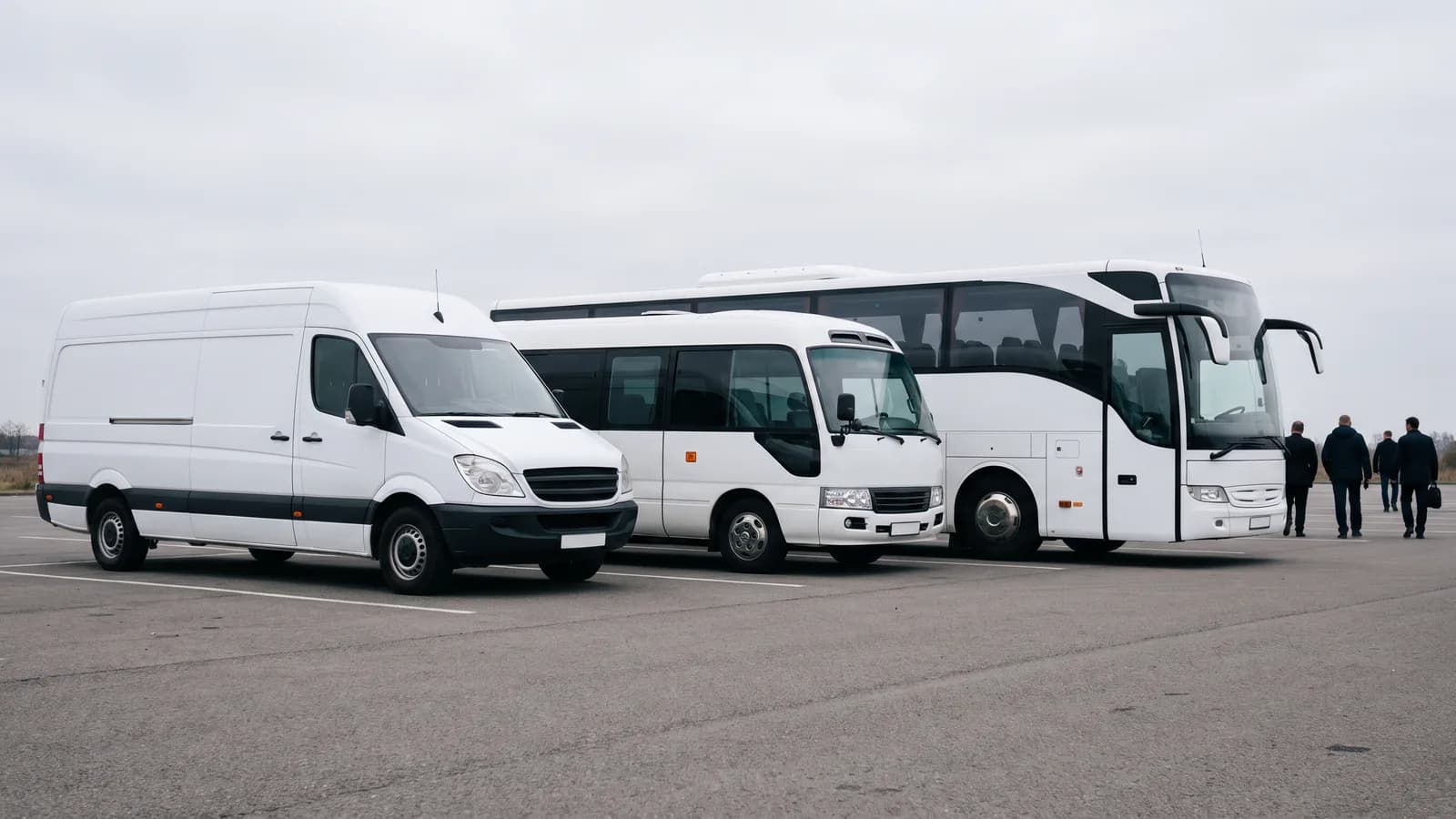
Representative shapes. Operators’ vehicles vary. More than 56 people? The quote form adds buses, or mix sizes.
Start with your headcount
Count everyone who rides: chaperones, staff, guides, the person with the clipboard. The driver isn't part of the count. Pick the class that fits with a little room to spare. If you're right at a class limit, look at the next size up when your group is bringing suitcases or gear, or when anyone uses a wheelchair. Both can take room that would otherwise be a seat.
- Up to 15 riders: Sprinter
- 16 to 26 riders: mini bus
- 27 to 56 riders: coach bus
- 57 or more: two or more buses, which the form adds
Seats vs. luggage
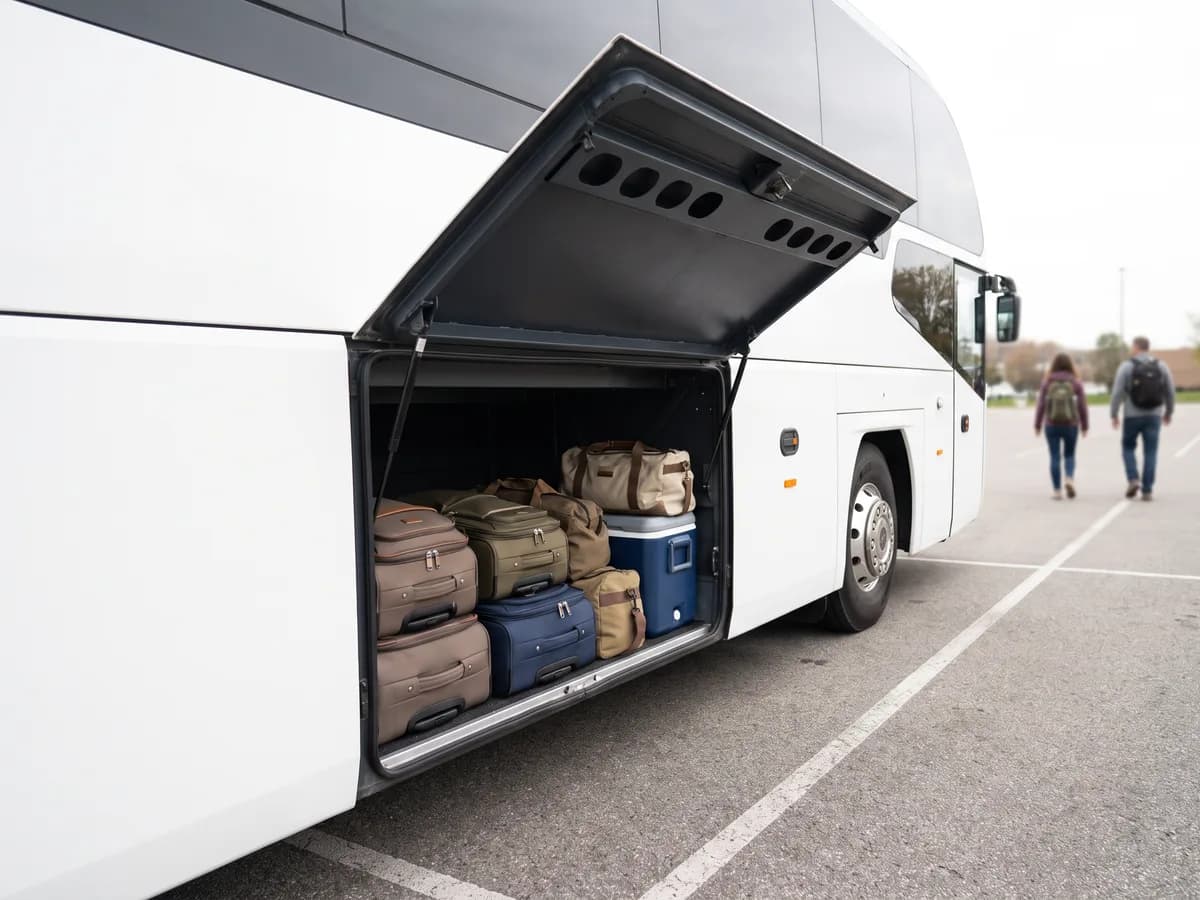
A seat count tells you how many people fit, not how many bags. Federal rules define an over-the-road bus, the legal term behind “motorcoach” (what we call a coach bus), as a bus with the passenger deck raised over a baggage compartment (49 CFR 37.3). Those under-floor bays are where suitcases, coolers and equipment cases ride.
A Sprinter has no under-floor bay; bags ride in the space behind the last row. A mini bus has a rear compartment or an under-floor bay, depending on the model. If your group is bringing more than a small bag each (an airport run, a tournament with equipment, a band with instruments), set Luggage to “Heavy (checked bags / gear)” when you get your price and say what you're bringing in Anything else?, so the match leans toward a bus with the room.
Restrooms
Don't assume a bus has an onboard restroom, at any size: many don't. If you need one, tick Onboard restroom when you get your price, and only a bus with one is booked. Plan rest stops on long drives either way.
A coach restroom may not be wheelchair-accessible, and federal rules allow for that. On an express run of three hours or more without a rest stop, if a rider with a disability can't use the onboard restroom and asks for an unscheduled stop, the operator must make a good-faith effort to accommodate. At any rest stop, riders with disabilities may get off and back on like everyone else, with help from the operator as needed (49 CFR 37.201).
Wheelchair lifts: what the rules say
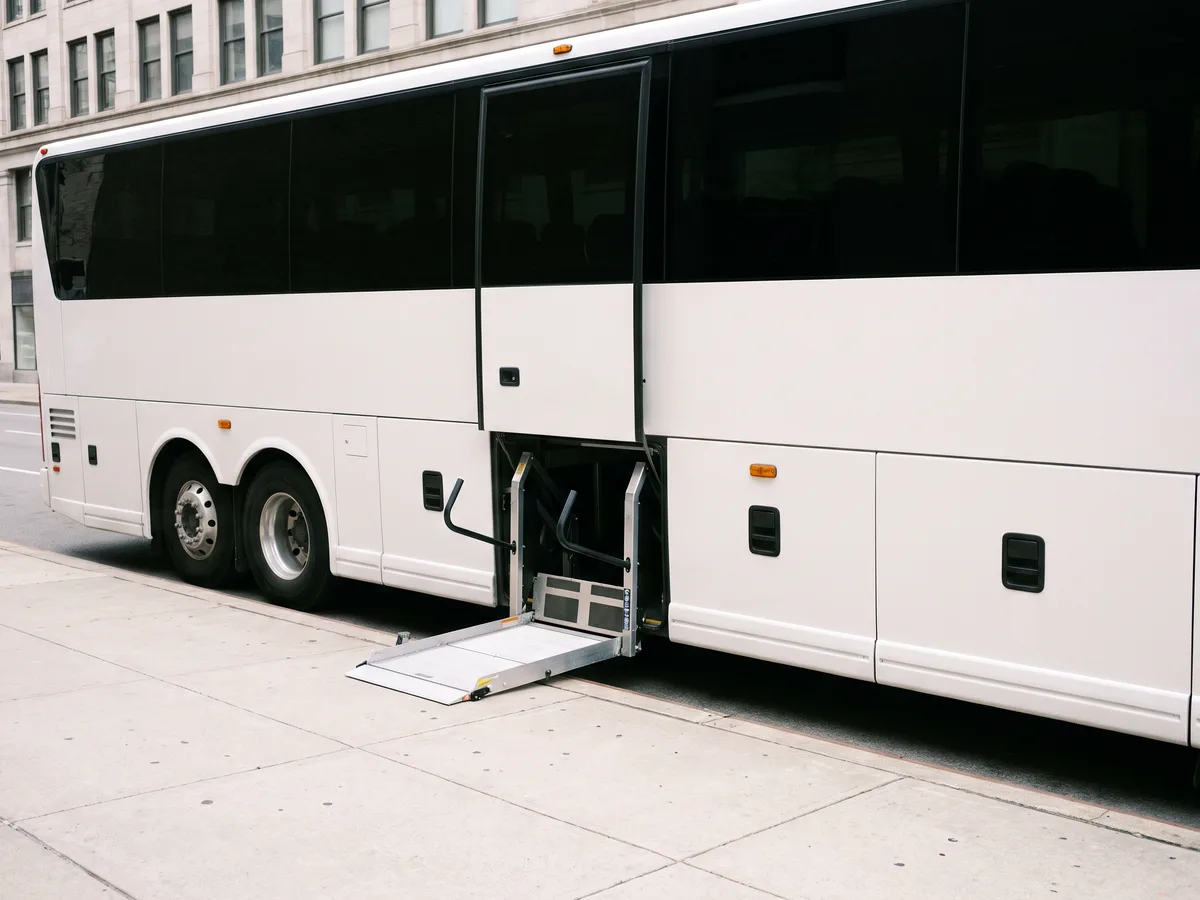
If anyone in your group uses a wheelchair or can't manage steps, tick the wheelchair-lift box when you get your price, or tell us as soon as you know. Lift-equipped buses are available on advance request, and the details are confirmed with you before the trip. Asking for a lift never changes the price.
For charters on over-the-road coaches, the U.S. DOT's Americans with Disabilities Act (ADA) rules say (49 CFR 37.189):
- The operator must provide an accessible bus to a rider with a disability who asks for one.
- It may require up to 48 hours' advance notice.
- With less notice, it must still provide one if it can do so with a reasonable effort.
- The rule's own example: a group books a charter four weeks ahead and learns a week before the trip that a rider needs an accessible bus. If the group tells the bus company more than 48 hours before the trip, the company must provide one.
Inside an accessible coach
An accessible coach has a lift or other boarding device and at least two wheelchair securement spaces. Those spaces can have fold-down seats that can't be used while a wheelchair is there, so the seat count can drop. Coach lifts must be designed for a load of at least 600 pounds, so if a rider's mobility device is especially large or heavy, mention it early (49 CFR 38.159).
If more riders use wheelchairs than there are spaces, spaces go first come, first served, and riders who can transfer are offered a regular seat (49 CFR 37.205). The operator can't require family or friends to handle routine boarding help unless the rider asks for it or agrees (49 CFR 37.207).
The 48-hour rule is written for over-the-road coaches. Smaller buses fall under other ADA sections (49 CFR 37.103 and 37.105), and an accessible bus 22 feet long or less may have only one securement space (49 CFR 38.23). The advice is the same at any size: tell us when you book, or as soon as you know.
Charter bus, coach, mini bus, Sprinter, school bus: what the words mean
These terms get used loosely. Here's what each one means.
- Charter bus: how the bus is hired, not a kind of bus. In federal terms, a charter is a group traveling together for a common purpose under one contract, with exclusive use of the bus (49 CFR 390.5). Any size can be a charter.
- Coach bus or motorcoach: the full-size highway bus. Federal law gives “motorcoach” the same meaning as “over-the-road bus”: a bus with the passenger deck raised over a baggage compartment.
- Mini bus: a trade name, not a separate federal class. To federal safety standards it's simply a bus, meaning a vehicle built to carry more than 10 people. Designs vary: luggage rides in a rear compartment or an under-floor bay, depending on the model. If you need a restroom, tick Onboard restroom rather than assuming one.
- Sprinter: a van-based shuttle, named after a common model. Built out for passengers it seats up to 15, with bags behind the last row or on laps.
- School bus: a federal category of its own, sold for carrying students to and from school or related events, with its own seating and crash-protection standard. SimpleShuttles never books school buses; the instant price covers the three classes on this page.
More than 56 people
The coach bus class goes up to 56, so a bigger group needs more than one bus. Enter your real headcount and the form adds buses of the size you pick, each priced like the first: 80 people is two coach buses. A bus running between two points all day is the form's Shuttle trip type. A round trip that comes back on a later day keeps the bus with your group, priced day by day. Extra stops go in the form and don't change the price unless they add a lot of miles.
What to sort out before you book
Tick the wheelchair-lift box on the form if you need one, set Luggage and Onboard restroom to match, and put the rest of this list in Anything else?:
- Your real headcount, including staff and chaperones
- Luggage and gear: suitcases, coolers, instruments, equipment cases
- How many riders use wheelchairs
- A restroom, if the drive is long
- Optional paid extras such as WiFi or leather seats. These are requested from the operator, not guaranteed; if the bus doesn't have one, it comes off your bill.
Who provides the bus
SimpleShuttles owns no buses. Your trip runs with an independent operator from its vetted network, which provides the bus and driver. Every operator is vetted before booking. Your confirmation email gives the operator's USDOT number and a link to its FMCSA SAFER record, and the day before the trip you get the driver's name and number. Planning a specific kind of trip? See group trips.
What the instant price covers
Instant price: one day or more on a Sprinter (up to 15 passengers), mini bus (up to 26) or coach bus (up to 56), with buses added past the class size, all-in (driver, fuel, gratuity, tolls, parking, repositioning miles and any tax). Extra stops go in the form. Past 56 people the form adds buses. Shuttles between two points are their own trip type. An overnight or multi-day round trip gets an instant price too.
How the price is built, what it includes and how booking works: How it works.
Common questions
How many people fit on a charter bus?
It depends on the size. SimpleShuttles prices three classes: a Sprinter for up to 15 passengers, a mini bus for up to 26 and a coach bus for up to 56. Groups larger than 56 need more than one bus, which the form adds and prices.
Do charter buses have restrooms?
Some do, at every size, and many don't. If you need one, tick Onboard restroom when you get your price, and only a bus with one is booked. Plan rest stops on long drives either way.
How much notice does an operator need for a wheelchair-accessible bus?
For coach charters, federal ADA rules let the operator require up to 48 hours' notice, and with less notice it must still provide one if it can with a reasonable effort (49 CFR 37.189). Tell us when you book, or as soon as you know: tick the wheelchair-lift box when you get your price.
Is a charter bus the same as a coach bus?
Not quite. “Charter” describes how the bus is hired: your group gets exclusive use of it. “Coach bus” or “motorcoach” describes the vehicle: a highway bus with a baggage compartment under the passenger deck. A charter can use any size of bus.
Can a mini bus carry our luggage?
A full-size coach carries bags in bays under the floor. A mini bus has a rear compartment or an under-floor bay, depending on the model, and a Sprinter carries bags in the space behind the last row. If you're bringing suitcases or gear, set Luggage to “Heavy (checked bags / gear)” when you get your price and say what it is in Anything else?.
Who provides the bus?
An independent operator from the SimpleShuttles network. SimpleShuttles owns no buses. Every operator is vetted before booking, and your confirmation email gives the operator's USDOT number and a link to its FMCSA SAFER record.
Keep planning
- How far can a charter bus go in a day?Federal rules give charter bus drivers 10 hours of driving and 15 on duty. What counts, how trucking differs, and when a day needs a second driver.
- Plan a group trip by charter busField trips, church retreats, team travel, corporate events, weddings and public-agency trips: a planner for each, plus how to pick the right bus.
Sources
Based on the primary sources below and fact-checked line by line, last on October 7, 2026. Rules change: the operator confirms what applies to your trip, and (704) 368-1515 answers questions 24/7.
- 49 CFR 37.3 defines an over-the-road bus as “a bus characterized by an elevated passenger deck located over a baggage compartment.” eCFR · checked 2026-10-05
- NHTSA's final rule of November 25, 2013 (78 FR 70416) quotes the Motorcoach Enhanced Safety Act: “the term 'motorcoach' has the meaning given the term 'over-the-road bus.'” GovInfo · checked 2026-10-05
- 49 CFR 390.5 defines charter transportation of passengers as transportation, using a bus, of a group who, pursuant to a common purpose, under a single contract, at a fixed charge for the vehicle, have acquired its exclusive use to travel together under an itinerary. eCFR · checked 2026-10-05
- 49 CFR 571.3 defines a bus as “a motor vehicle with motive power, except a trailer, designed for carrying more than 10 persons,” and a school bus as a bus sold or introduced in interstate commerce for purposes that include carrying students to and from school or related events. eCFR · checked 2026-10-07
- FMVSS No. 222, “School bus passenger seating and crash protection,” applies to school buses. eCFR · checked 2026-10-05
- 49 CFR 37.189: demand-responsive OTRB operators must provide accessible service on request (b), may require up to 48 hours' notice (c), and without it must still provide service if they can with a reasonable effort (d). Example 2: a group books four weeks ahead, learns a week out that a rider needs an accessible bus, and tells the company more than 48 hours ahead; “The bus company must provide an accessible bus.” eCFR · checked 2026-10-07
- 49 CFR 38.159 requires a lift or ramp and at least two securement locations; securement areas may have fold-down seats when no wheelchair is there; the lift design load must be at least 600 pounds. eCFR · checked 2026-10-07
- 49 CFR 38.23(a): accessible buses and vans over 22 feet long need at least two securement locations; those 22 feet or less need at least one. eCFR · checked 2026-10-07
- 49 CFR 37.205: when wheelchair users outnumber securement locations, the locations are assigned first come, first served, and passengers without one must be offered boarding assistance and a vehicle seat. eCFR · checked 2026-10-05
- 49 CFR 37.207(b): an operator discriminates if it uses or requests people other than its own employees (e.g., family members or companions) for routine boarding assistance, unless the passenger requests or consents. eCFR · checked 2026-10-05
- 49 CFR 37.201: passengers with disabilities may leave and return to the bus at rest stops on the same basis as others, with assistance; on an express run of three hours or more without a rest stop, a passenger who can't use an inaccessible restroom may ask for an unscheduled stop and the operator must make a good-faith effort to accommodate. eCFR · checked 2026-10-07
- 49 CFR 37.103: a private entity primarily in the business of transporting people that buys or leases a new non-OTRB vehicle (other than an automobile or small van) for demand-responsive service must make it accessible, unless its system meets the equivalent-service standard in 37.105. eCFR · checked 2026-10-05
Photos are illustrative. Your bus is the size you book; its make, model, colors and markings vary by operator.