Charter buses for corporate events
One bus for a day, or a shuttle program?
The instant price covers as many buses as your headcount needs, for one day or several: an offsite at a retreat venue, a client site visit, a team-building day, a dinner at an off-site venue and back, or a group landing on the same flight. For a round trip that comes back on a later day, set the return date to that day: the bus stays with your group, and you add the hours you'll use it each day. The driver's hotel room, and the bus's overnight parking if your hotel doesn't allow buses, are the group's cost on top.
A bus running between the hotel and the venue all day is the form's Shuttle trip type: give the service window, the runs you need (or leave it nonstop) and how many buses. Pickups at several offices on the same morning are extra stops in the form. A whole program goes to our enterprise team, who plan it with you:
- A conference with shuttles running every day.
- Ongoing employee shuttles, such as a daily run between two sites.
Staging at the hotel or venue
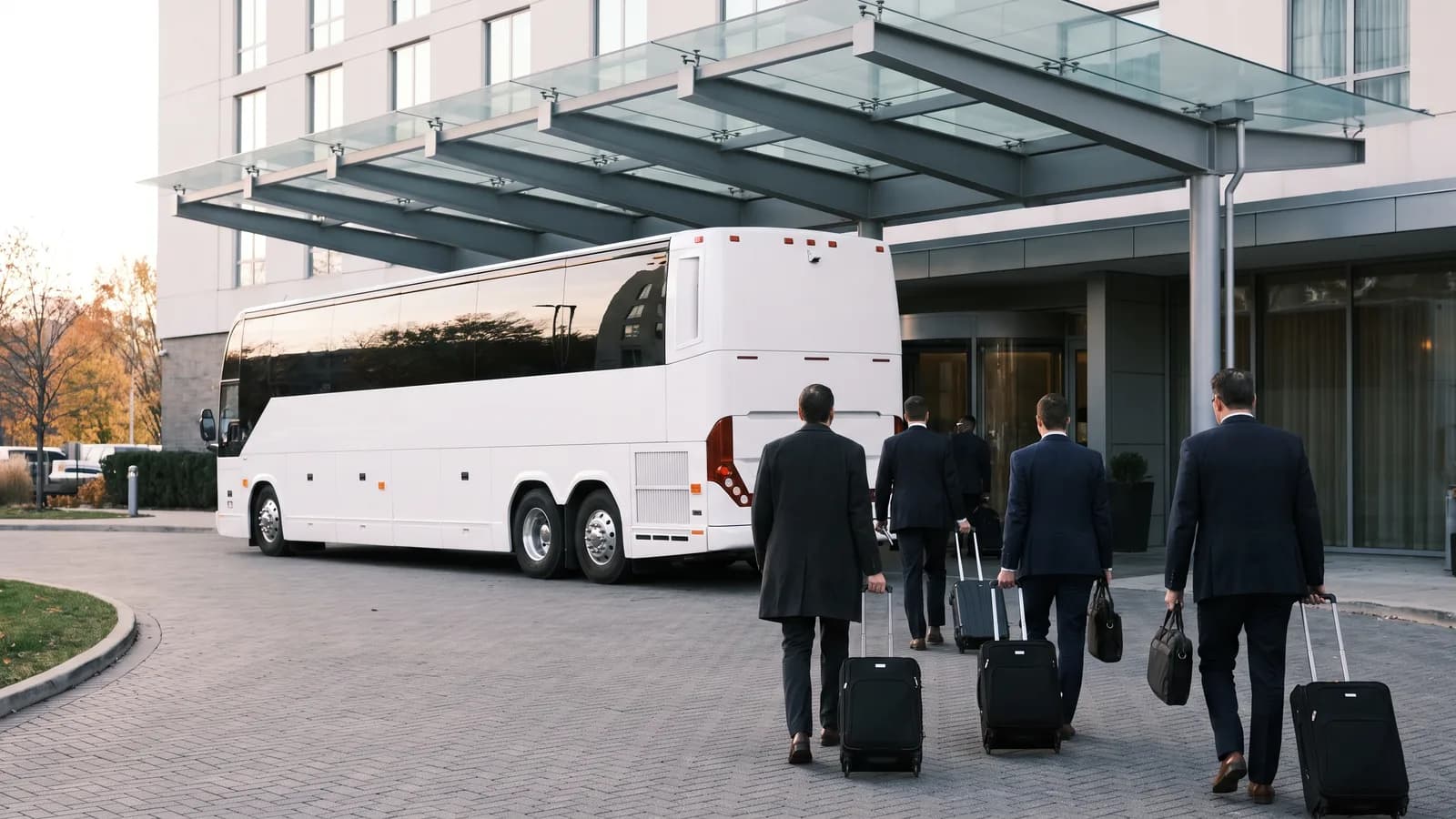
Federal rules don't let states hold buses to less than 45 feet on the main highway network (23 CFR 658.13), so a full-size coach can be that long. Ask the hotel or venue where a vehicle that size can load and wait, and whether a covered entrance has the clearance.
Name one on-site lead with a cell phone. The day before the trip you get the driver's name and number; hand them to the lead so the two can settle the pickup point directly.
For airport arrivals, set the pickup after the last scheduled landing, with time for bags, give the flight number (the form asks for it when an address is an airport), and tell travelers exactly where to meet the bus. Arrivals spread across the day mean several runs, so call.
Leave slack in the return time. Dinners and closing sessions run long, and the price covers the schedule you book; changes you make aren't included.
Accessibility: ask early, and ask how many
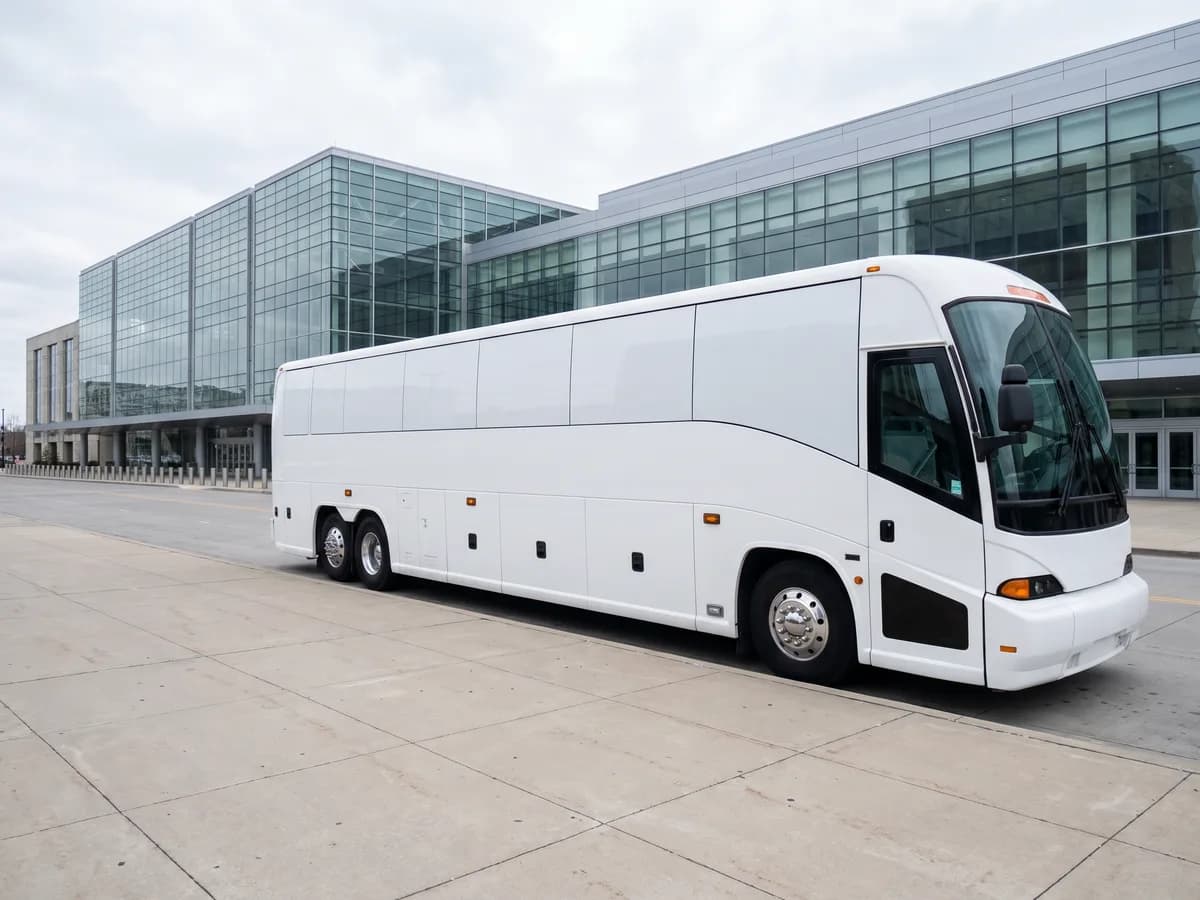
Wheelchair-lift buses are available on advance request: tick the box when you get your price, and the lift is confirmed with you before the trip. Charter coach operators may require up to 48 hours' notice for an accessible bus (49 CFR 37.189). The rule's own example is a charter group that learns a week out that a traveler needs an accessible bus; because the group tells the bus company more than 48 hours ahead, the company must provide one. Asking for a lift never changes the price.
Put an accessibility question on event registration, and ask how many people need a wheelchair space. An accessible coach must have at least two securement locations (49 CFR 38.159). If more riders need one than the bus has, spaces go first come, first served, and the others are offered a regular seat with boarding help (49 CFR 37.205). Service animals ride with their handlers (49 CFR 37.167).
Paperwork and payment
If your company needs a Form W-9 before paying a new vendor, ask for one: SimpleShuttles LLC sends it on request, and will register in your vendor system and fill in supplier onboarding forms if your company needs that. A W-9 is the IRS form a business uses to give its taxpayer identification number to whoever has to file an information return. If your venue or legal team needs proof of insurance, ask once your operator is confirmed: we'll send the operator's certificate of insurance naming your company or venue as certificate holder within 3 business days.
A small deposit books the trip. The balance is charged 14 days before the trip, with an email 7 days before; a trip booked 14 days out or closer is paid in full when you book. Pay by card or bank; the all-in price includes any tax, and nothing is added at checkout. If accounts payable needs an invoice in the company's name, ask for one. If it can only pay against a purchase order or by check, call (704) 368-1515 before you book. Paying after the trip is arranged only for certain enterprise clients, by inquiry.
Event dates move, so read the cancellation policy before you commit. Refunds step down from 100% at 14 or more days out to nothing inside 7 days.
Duty of care: what you can check yourself
Every operator is vetted before booking: active FMCSA passenger authority, current insurance, a safety rating that isn't Unsatisfactory or Conditional, no out-of-service order, and a fleet that fits the trip. Your confirmation email gives the operator's USDOT number and a link to its FMCSA SAFER record, so your travel or risk team can look for itself.
- SAFER shows the operator's safety rating (if any), a summary of roadside out-of-service inspections and crash information.
- “Unrated” means FMCSA hasn't assigned a rating, not that the operator failed one. Conditional and Unsatisfactory mean FMCSA found the carrier's safety controls inadequate (49 CFR 385.3).
- Federal rules set minimum liability coverage for interstate for-hire bus companies, with a higher minimum for vehicles seating 16 or more including the driver (49 CFR 387.33).
- Federal rules require drivers of vehicles designed for 16 or more people, including the driver, to hold a commercial driver's license with a passenger endorsement (49 CFR 383.5, 383.93), to pass a drug test before they start, and to be in a random drug and alcohol testing program (49 CFR 382.301, 382.305).
- Hours limits apply on every trip; the driver-hours guide covers long days.
WiFi and other extras
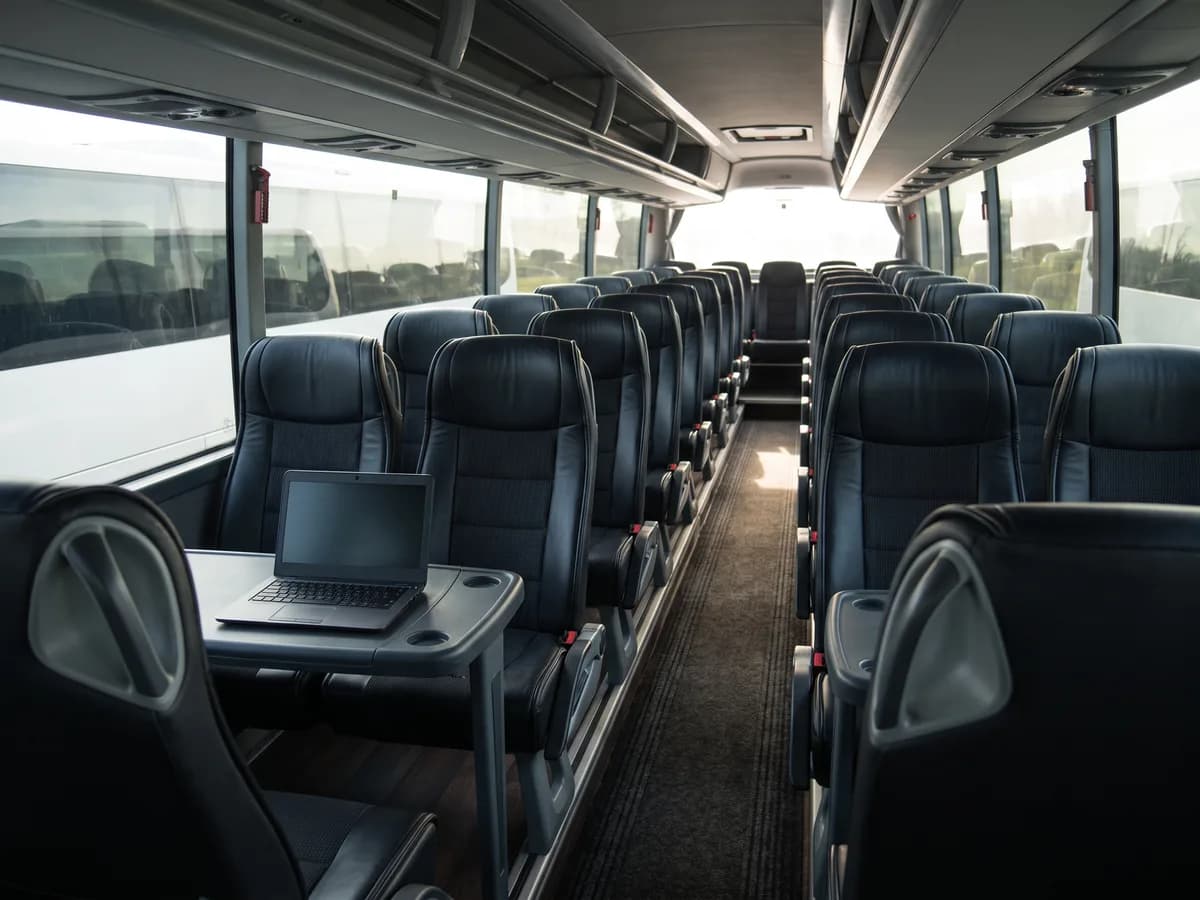
WiFi and leather seats can be requested as paid extras. They're not guaranteed: if the bus doesn't have one, it comes off the bill. Don't plan a working session or a presentation that depends on onboard WiFi. More on how it works.
Planner checklist
- Final headcount, including hosts and staff.
- Exact pickup and drop-off points: which hotel entrance, which venue door.
- Where a coach up to 45 feet long can load and wait, confirmed with the hotel or venue.
- One on-site lead with a cell phone to take the driver's details the day before.
- Accessibility needs from registration, including how many wheelchair spaces.
- Any vendor paperwork your company needs: our W-9, and the operator's certificate of insurance once the operator is confirmed.
- Who approves the deposit, and the card or bank account for the balance.
- Extras requested (WiFi, leather seats), knowing they're not guaranteed.
- A return time with slack for sessions or dinners that run long.
- The operator's SAFER record checked from the link in your confirmation.
What the instant price covers
Instant price: one day or more, any headcount (past 56 people the form adds buses), such as an offsite, a client visit, a dinner out and back, or one airport pickup for a group on the same flight, all-in (driver, fuel, gratuity, tolls, parking, repositioning miles and any tax). Extra stops go in the form, and a round trip that comes back on a later day keeps the bus with your group. A shuttle that repeats daily goes to our enterprise team (/enterprise).
How the price is built, what it includes and how booking works: How it works.
Common questions
How do we pay?
A small deposit books the trip. The balance is charged 14 days before the trip; a trip booked 14 days out or closer is paid in full when you book. Pay by card or bank; the price includes any tax. Need an invoice in the company's name? Ask. If your company can only pay against a purchase order or by check, call (704) 368-1515 before you book.
Can a bus run between the hotel and the venue all day?
Yes. Pick Shuttle in the form, give the start and end of the service window, the runs you need (or leave it nonstop) and how many buses, and it's priced on the spot.
Can we book a bus for next week?
Yes. A trip booked 14 days out or closer is paid in full when you book. If no operator can be found, everything is refunded, but a cancellation less than 7 days before the trip isn't.
Can our risk team see who the operator is?
Yes. Your confirmation email gives the operator's USDOT number and a link to its FMCSA SAFER record.
Can people drink on the bus after a client dinner or holiday party?
Yes, if you ask ahead. Tick “Alcohol allowed onboard” when you get your price and we book an operator that allows it; it can't be arranged on the day. Your state's open-container law still applies to passengers, and the driver never drinks.
Who do we call on the day?
(704) 368-1515, answered 24/7. The day before the trip you also get the driver's name and number.
Keep planning
- How far can a charter bus go in a day?Federal rules give charter bus drivers 10 hours of driving and 15 on duty. What counts, how trucking differs, and when a day needs a second driver.
- Which charter bus fits your group?Sprinter, mini bus or coach bus? How seats, luggage, restrooms and wheelchair lifts differ, and what to do past 56 riders.
- Charter buses for government agencies and public eventsWhat procurement offices may ask for (W-9, vendor setup, insurance, SAM.gov), how payment works, ADA duties for public events, and driver-hours limits.
- Wedding shuttle buses, planned around your dayPlan wedding guest shuttles: hotel-to-venue timing, how many buses or runs, alcohol and decoration rules, wheelchair lifts, and what to tell guests.
- Plan a group trip by charter busField trips, church retreats, team travel, corporate events, weddings and public-agency trips: a planner for each, plus how to pick the right bus.
Sources
Based on the primary sources below and fact-checked line by line, last on October 7, 2026. Rules change: the operator confirms what applies to your trip, and (704) 368-1515 answers questions 24/7.
- 23 CFR 658.13(d): “No State shall impose a limit of less than 45 feet on the length of any bus on the NN” (the National Network of highways). eCFR · checked 2026-10-07
- 49 CFR 37.189(c): a demand-responsive over-the-road bus operator may require up to 48 hours' advance notice to provide an accessible bus. Example 2 in (e): a group charters four weeks ahead, learns a week before that a rider needs an accessible bus, and tells the bus company more than 48 hours before the trip; the company must provide one. eCFR · checked 2026-10-07
- 49 CFR 38.159(a)(1): accessible over-the-road buses must provide a lift or ramp and at least two securement locations and devices. eCFR · checked 2026-10-07
- 49 CFR 37.205: if more wheelchair users seek to travel than the bus has securement locations, the operator assigns them first come, first served and must offer the others boarding assistance and a vehicle seat. eCFR · checked 2026-10-05
- 49 CFR 37.167(d): the entity shall permit service animals to accompany individuals with disabilities in vehicles and facilities. eCFR · checked 2026-10-05
- IRS: use Form W-9 to provide your correct Taxpayer Identification Number (TIN) to the person who is required to file an information return with the IRS. IRS · checked 2026-10-07
- 49 CFR 385.3: an unrated carrier is one to which FMCSA has not assigned a safety rating; Conditional and Unsatisfactory ratings mean the carrier does not have adequate safety management controls in place. eCFR · checked 2026-10-05
- 49 CFR 387.33(a): for-hire passenger carriers in interstate commerce must meet minimum public-liability financial responsibility levels, higher for vehicles seating 16 or more passengers including the driver than for 15 or fewer. eCFR · checked 2026-10-05
- 49 CFR 383.5: a vehicle designed to transport 16 or more passengers, including the driver, is a commercial motor vehicle for CDL purposes; 49 CFR 383.93(b)(2) requires a State-issued passenger endorsement to operate passenger CMVs. eCFR · checked 2026-10-05
- 49 CFR 382.301(a): before a driver first performs safety-sensitive functions, the employer must receive a verified negative drug test result; 49 CFR 382.305(a): every driver shall submit to random alcohol and controlled substance testing. eCFR · checked 2026-10-05
- FMCSA's SAFER Company Snapshot shows a company's identification, size, safety rating (if any), a roadside out-of-service inspection summary and crash information, searchable by USDOT number, MC/MX number or name. safer.fmcsa.dot.gov · checked 2026-10-07
Photos are illustrative. Your bus is the size you book; its make, model, colors and markings vary by operator.