Wedding shuttle buses, planned around your day
Start with the timeline
Write the day as legs: hotel to ceremony, ceremony to reception, reception back to the hotel. Put a time on each one. If the ceremony and reception are at the same venue, you may only need two legs: there and back. On a there-and-back day the bus drops guests and comes back for the return; if you need it to stay at the venue, say so in Anything else?.
Work backward from the ceremony. Guests should be seated before it starts, so plan for the bus to arrive early, and leave time for boarding. A full coach doesn't load in two minutes.
Fix the return time before you book. Guests plan their evening around the last bus home, so pick a time, publish it and keep it. Settle these four times first:
- First pickup: the time and the exact place
- Ceremony start
- Reception end
- Last departure from the venue
Count riders, then choose buses or runs
Count the guests who need a ride, not everyone invited. Locals and guests with cars may drive themselves. Add one line to the RSVP: “Will you ride the shuttle from the hotel?” Plan a seat for every rider, children included.
A Sprinter seats up to 15, a mini bus up to 26 and a coach bus up to 56. More riders than one bus holds? You have two choices: more buses at the same time, or one bus making more than one run. Two buses get everyone there together. One bus running twice means the first group arrives earlier and waits. Say 80 guests need a ride: that's two buses, which the form adds and prices, or one 56-seat coach running twice, which is the form's Shuttle trip type.
Two hotels or a second venue? Call
The instant price covers one day, from one pickup to one destination, with buses added past 56 people, one way or there and back the same day. A bus looping between the hotel and the venue is the form's Shuttle trip type: give the window and the runs you need. Your wedding may need more: guests split between two hotels, or a ceremony and reception in different places.
Those are priced by a person; the phone is answered 24/7. A welcome dinner the night before or a brunch the morning after is its own trip on its own day: book it online separately.
Plan for the driver's day
Federal rules cap a bus driver's day on interstate trips: no more than 10 hours of driving, and no driving after 15 hours on duty, both counted from the last 8 consecutive hours off (49 CFR 395.5).
Waiting can count. Under FMCSA guidance, a driver is off duty at a stop only when relieved of all responsibility for the bus and its passengers and free to do as they choose. A driver who stays with the bus through the reception is usually still on duty, so an afternoon pickup and a late send-off make a long day.
Enter your real pickup and return times when you get your price, and check a long day with the driver-hours guide.
Alcohol on the bus: tick the box
The driver can't drink. Federal rules bar commercial bus drivers from drinking on duty or working within 4 hours after drinking (49 CFR 382.205 and 382.207). If you're feeding your vendors, give the driver a plate and a soft drink.
Guests are a separate question. The federal rule that bars drivers from having alcohol aboard exempts alcohol carried by bus passengers (49 CFR 392.5), and federal open-container rules let states allow passengers, but not drivers, to drink in vehicles hired to carry people (23 CFR 1270.4). So it comes down to your state's law and the operator's own rules.
If you want guests to be able to drink on the way home, tick “Alcohol allowed onboard” when you get your price, so we book an operator that allows it. Ask ahead: it can't be arranged on the day. Ask about the operator's rules on containers and cleanup before you promise guests anything.
Decorations: ask first, and know the limits
It's the operator's bus, so ask before you decorate. A few limits apply either way:
- Nothing on the windshield. The driver needs a clear view, and federal rules strictly limit what can go on a bus windshield (49 CFR 393.60). A “Just Married” sign goes somewhere else, if the operator agrees.
- Exits stay clear. Centerpieces, gift boxes and garment bags must be stowed so every passenger can reach every exit (49 CFR 392.62).
- No confetti, glitter or loose petals inside. Extra cleaning and damage aren't included in the price.
Guests with mobility needs
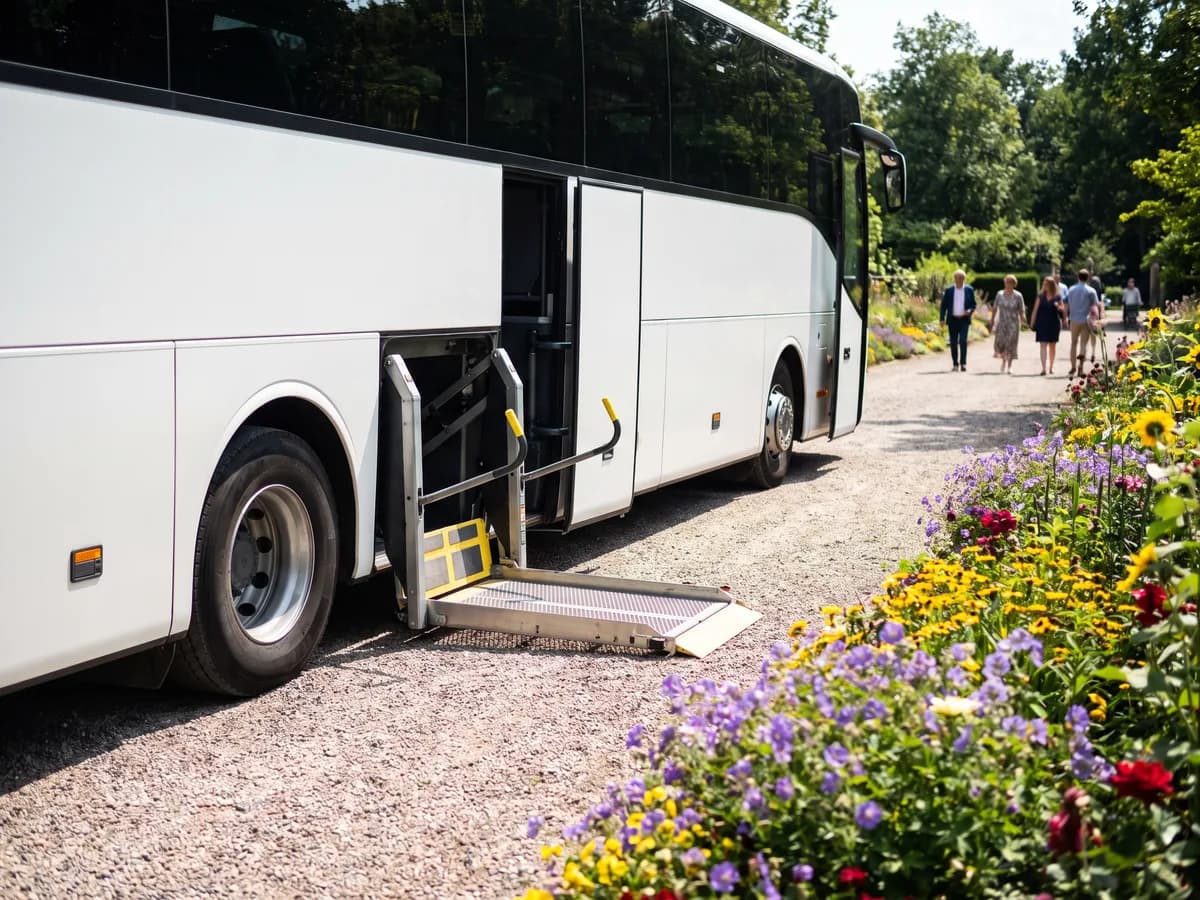
Wheelchair-lift buses are available on advance request. Tick “Wheelchair lift (ADA accessible)” when you get your price, and the lift is confirmed with you before the trip. Charter coach operators may ask for up to 48 hours' notice (49 CFR 37.189), so put a mobility question on the RSVP and tell us as soon as you know. Asking for a lift never changes the price.
Say how many guests will ride in their wheelchairs. An accessible full-size coach has at least two wheelchair spaces (49 CFR 38.159), while an accessible bus 22 feet long or less may have only one (49 CFR 38.23).
What to tell guests
Put the shuttle details on the wedding website and on a card in the welcome bag. Guests need four things:
- Where to board: the exact spot, agreed with the hotel
- When the bus leaves, and that it leaves on time
- When it comes back from the venue, including the last departure
- Who to call on the day: your point person, not the couple
Before the day
Pick that point person now: a planner, a cousin, a groomsman. The day before the trip, the operator confirms the driver and bus, and you get the driver's name and number. Hand both to your point person.
Ask the venue and the hotel where a bus can stop and turn around. A narrow drive or a tight gate may call for a smaller bus.
One less envelope: the price includes the driver's gratuity, along with fuel, tolls and parking, so nothing is added at pickup.
Booking, paying and changing plans
A small deposit books the trip. The balance is charged 14 days before the trip, with an email 7 days before; a trip booked 14 days out or closer is paid in full when you book. Pay by card or bank; the price includes any tax. Changes you make after booking aren't included in the price, so settle the headcount and times first. If the night runs past the booked return, the extra time is billed afterwards by the hour.
Cancel 14 or more days before the trip and you get 100% back; 7 to 13 days, 50%; under 7 days, nothing. A postponed date is handled the same way: the schedule applies to the booked date, and the new date is a new booking. If no operator can be found, or yours can't run and can't be replaced, you get everything back. Your confirmation email has the operator's USDOT number and a link to its FMCSA SAFER record.
Planner checklist
- Count riders, not guests, and add a shuttle question to the RSVP
- Write the timeline: first pickup, ceremony start, reception end, last departure
- Agree the pickup spot with the hotel, and ask the venue where a bus can stop and turn around
- Decide: one pickup to one venue (instant price), a bus looping all evening (Shuttle), or a second day (call); extra stops and a second bus go in the form
- Tick “Wheelchair lift (ADA accessible)” if any guest needs it, and say how many
- If you want guests to drink on board, call before you book and learn the operator's rules
- Clear any decorations with the operator: nothing on the windshield or in front of exits
- Choose a point person and give them the driver's name and number the day before
- Publish the pickup spot, departure times and the point person's number on the wedding website
What the instant price covers
Instant price: one day, any headcount (past 56 people the form adds buses), from one pickup to one destination, such as one hotel to one venue and back, all-in (driver, fuel, gratuity, tolls, parking, repositioning miles and any tax). Two hotels or separate ceremony and reception venues are extra stops in the form; a hotel-to-venue loop is the Shuttle trip type. A second day is its own booking.
How the price is built, what it includes and how booking works: How it works.
Common questions
Does the online price cover our wedding shuttle?
It does if your day is one day, from one pickup to one destination; past 56 riders the form adds buses. A hotel-to-venue loop is the Shuttle trip type. Two hotels or a separate reception venue: call (704) 368-1515 and a person prices it by hand. A second day, like a welcome dinner or a brunch, is its own trip: book it separately.
How many buses do we need?
Count riders, not guests. A Sprinter seats up to 15, a mini bus up to 26 and a coach bus up to 56. More riders than that means a second bus, which the form adds and prices, or a second run, which is the form's Shuttle trip type.
Can guests drink on the shuttle?
Yes, if you ask ahead and your state allows it. Tick “Alcohol allowed onboard” when you get your price and we book an operator that allows it; it can't be arranged on the day. The driver can't drink on duty or in the 4 hours before.
Can we decorate the bus?
Ask the operator first. Keep the windshield and exits clear, and skip confetti, glitter and loose petals inside: extra cleaning and damage aren't included in the price.
Do we need to tip the driver?
No. Gratuity is included in the price, along with fuel, tolls and parking, so nothing is added at pickup.
Can a guest who uses a wheelchair ride?
Yes, on a wheelchair-lift bus requested in advance. Tick “Wheelchair lift (ADA accessible)” when you get your price and tell us how many guests use wheelchairs. The lift is confirmed with you before the trip.
How far ahead should we book?
As soon as your venue, hotel and times are set. A small deposit books the trip, and if you cancel 14 or more days out, you get 100% back. Online booking closes 8 hours before the pickup; closer than that, call (704) 368-1515 and we'll arrange it by phone.
Keep planning
- Which charter bus fits your group?Sprinter, mini bus or coach bus? How seats, luggage, restrooms and wheelchair lifts differ, and what to do past 56 riders.
- How far can a charter bus go in a day?Federal rules give charter bus drivers 10 hours of driving and 15 on duty. What counts, how trucking differs, and when a day needs a second driver.
- Charter buses for corporate eventsPlan a bus for an offsite, conference dinner or airport arrival: venue staging, accessible coaches, vendor paperwork and how to check the operator.
- Charter buses for church trips, retreats and youth groupsPlan a church trip or retreat by bus: sizing for mixed ages, retreat luggage, lift access for older members, Sunday timing and multi-day driver rest.
- Plan a group trip by charter busField trips, church retreats, team travel, corporate events, weddings and public-agency trips: a planner for each, plus how to pick the right bus.
Sources
Based on the primary sources below and fact-checked line by line, last on October 7, 2026. Rules change: the operator confirms what applies to your trip, and (704) 368-1515 answers questions 24/7.
- 49 CFR 395.5(a): a passenger-carrying CMV driver may not drive more than 10 hours following 8 consecutive hours off duty, or drive after having been on duty 15 hours following 8 consecutive hours off duty. eCFR · checked 2026-10-07
- 49 CFR 390.3(a): the FMCSRs in subchapter B (including Parts 392, 393 and 395) apply to employers, employees and commercial motor vehicles that transport passengers in interstate commerce. eCFR · checked 2026-10-05
- FMCSA regulatory guidance (78 FR 41852, July 12, 2013): a driver may record a stop as off duty only if relieved of all duty and responsibility for the care and custody of the vehicle, its accessories and any cargo or passengers, and at liberty to pursue activities of his or her own choosing for the duration of the stop. GovInfo · checked 2026-10-07
- 49 CFR 382.207 and 382.205: no driver shall perform safety-sensitive functions within four hours after using alcohol, and no driver shall use alcohol while performing safety-sensitive functions. eCFR · checked 2026-10-05
- 49 CFR 392.5(a)(3)(ii): the ban on a driver being on duty while possessing wine, beer or distilled spirits does not apply to alcohol “possessed or used by bus passengers.” eCFR · checked 2026-10-07
- 23 CFR 1270.4(d)(2): a State open-container law that bans possession and consumption by the driver (but not by a passenger) in the passenger area of a vehicle designed, maintained or used primarily to transport persons for compensation is treated as compliant. eCFR · checked 2026-10-07
- 49 CFR 393.60(e) prohibits obstructions to the driver's field of view; only CVSA inspection decals and stickers or decals required by federal or state law may be placed on the windshield, at the bottom or sides, within set limits. eCFR · checked 2026-10-05
- 49 CFR 392.62(c): no bus may be driven unless baggage or freight is stowed and secured so that any occupant has unobstructed access to all exits. eCFR · checked 2026-10-05
- 49 CFR 37.189(c): private demand-responsive over-the-road bus operators may require up to 48 hours' advance notice to provide an accessible bus. eCFR · checked 2026-10-07
- 49 CFR 38.159(a)(1): an accessible over-the-road bus must have a lift or ramp and at least two securement locations. eCFR · checked 2026-10-07
- 49 CFR 38.23(a): accessible buses and vans over 22 feet long must have at least two securement locations; those 22 feet or less must have at least one. eCFR · checked 2026-10-07
Photos are illustrative. Your bus is the size you book; its make, model, colors and markings vary by operator.