Charter buses for government agencies and public events

Who you pay, and who drives
SimpleShuttles LLC, a North Carolina company, is a charter bus broker. It arranges your trip with an independent bus operator and owns no buses. That split decides whose paperwork is whose.
Payee paperwork, such as a W-9 or a vendor record in your system, would be for SimpleShuttles LLC, the company you pay. Insurance, operating authority and safety records belong to the operator, the company that runs the bus.
What your procurement office may ask for
Get your office's list in writing before you book, then call (704) 368-1515 with it; the phone is answered 24/7. SimpleShuttles LLC sends a W-9 on request and registers in your vendor system if you need it. The list may include:
- IRS Form W-9. It's how a payer gets a vendor's correct taxpayer identification number for IRS information returns.
- Registration in your own system. Your state, county or city may require vendors to register in its purchasing system before doing business with them.
- Proof of insurance. On a brokered trip, the insurance is the operator's. Federal rules set minimum insurance levels for interstate passenger carriers by seating capacity (49 CFR 387.33). Once your operator is confirmed, we'll send its certificate of insurance naming your agency as certificate holder within 3 business days of your request.
- SAM.gov, for federal buys. Registration lets an entity bid on federal contracts and apply for federal assistance. The FAR requires offerors and quoters to be registered when they submit an offer or quote, with exceptions. One is a purchase under the micro-purchase threshold that uses a government purchase card to both buy and pay, not just to pay (FAR 4.1102). SimpleShuttles LLC isn't registered in SAM.gov yet (registration is planned), so a federal buy that needs a registered vendor isn't possible yet; a purchase-card buy under the micro-purchase threshold is.
- A schedule contract, if yours requires one. GSA's Multiple Award Schedule has a ground transportation category, SIN 485, for the “timely pickup and delivery of government personnel.” If your office must buy through a schedule or another contract vehicle, settle that before you collect quotes.
How payment works, and what to check first
Pay by card or bank, and a government purchase card works like any other card. A small deposit books the trip. The balance is charged 14 days before the trip, with an email 7 days before; a trip booked 14 days out or closer is paid in full when you book. The all-in price includes any tax, and you can ask for an invoice in your agency's name. Need approval before anyone pays? Unlock your price with your email and we'll email you the saved quote, ready to forward.
Check your rules on paying ahead. For federal buyers, a payment for a service generally can't be more than the value already delivered, and an advance needs specific authorization (31 U.S.C. 3324). State and local rules vary; ask your finance office what applies to you.
If your office can only pay against a purchase order or by check, call before you book; both are possible for some agencies. Paying after the trip is arranged only for certain enterprise clients, by inquiry. Check the refund schedule against your rules too: cancel 14 or more days out and everything comes back; inside 7 days, nothing does.
Accessibility for public events and programs
ADA Title II requires state and local governments to give people with disabilities an equal opportunity to benefit from all of their programs, services and activities, transportation included. Hiring a contractor doesn't change that: a public entity can't discriminate “directly or through contractual, licensing, or other arrangements” (28 CFR 35.130).
DOT's ADA rules say the same for transportation. When a public entity has a private company operate fixed-route or demand-responsive service, it must make sure the company meets the rules that would apply if the entity ran the service itself (49 CFR 37.23). Federal agencies' own programs are covered by Section 504 of the Rehabilitation Act.
So plan accessible buses from the start:
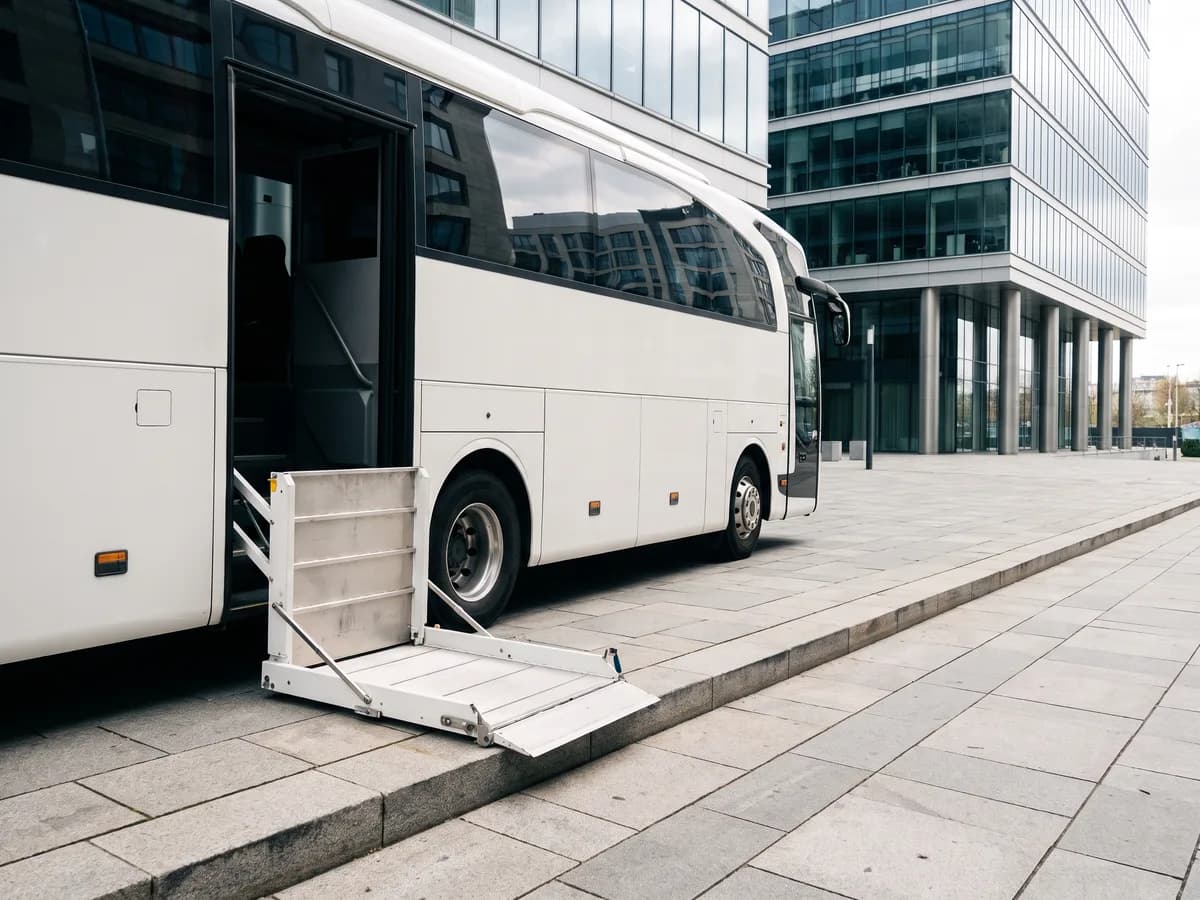
- Tick “Wheelchair lift (ADA accessible)” when you get your price. Wheelchair-lift buses are available on advance request, and the lift is confirmed with you before the trip. Asking for a lift never changes the price.
- Count wheelchair users separately. An accessible full-size coach has at least two securement spaces (49 CFR 38.159), so a public event may need more than one accessible bus.
- Book early. Charter coach operators may ask for up to 48 hours' notice for an accessible coach (49 CFR 37.189).
Long official days
On interstate trips, a bus driver may drive up to 10 hours and may not drive after 15 hours on duty, both counted from the last 8 consecutive hours off, with weekly caps of 60 or 70 hours on duty (49 CFR 395.5).
Both daily limits reset only after 8 hours off in a row. A late official dinner followed by an early airport run can be too much for one driver, and a multi-day conference adds up against the weekly cap. Send the full itinerary, every gap included, and see the driver-hours guide.
Delegations, secure sites and checking the operator
Name one coordinator. The day before the trip, the operator confirms the driver and bus, and you get the driver's name and number. The coordinator should hold both.
If the route enters a secure site, such as a military installation, a federal building or a port, get the site's vehicle and driver access rules early and send them to us before you book. Operators can usually meet requests such as driver background checks or site pre-clearance, given notice.
Every operator is vetted before booking: active FMCSA passenger authority, current insurance, no Unsatisfactory or Conditional rating, no out-of-service order, and a fleet that fits. Your confirmation email has the operator's USDOT number and a link to its FMCSA SAFER record, so your risk office can check it too. On FMCSA's Bus Safety Search, look for “Yes” next to “Passenger” under active for-hire authority, and for insurance on file.
Planner checklist
- Get your office's vendor requirements in writing: W-9, vendor registration, proof of insurance
- Federal buys: SimpleShuttles LLC isn't in SAM.gov yet; confirm whether your buy needs a registered vendor or a schedule contract (GSA MAS, SIN 485)
- Confirm your office can pay a deposit and a balance before the trip, by card (a purchase card is fine) or bank
- Check the refund schedule against your funding rules
- Count riders, and count wheelchair users separately
- Tick “Wheelchair lift (ADA accessible)” for public events and programs, and book early
- Write the full day's schedule, every gap included, for driver hours
- Get the access rules for any secure site on the route
- Name one coordinator to hold the driver's name and number
- When the confirmation arrives, check the operator's USDOT number on SAFER
What the instant price covers
Instant price: one day or more, any headcount (past 56 people the form adds buses), such as a day trip to a conference center two hours away, all-in (driver, fuel, gratuity, tolls, parking, repositioning miles and any tax). Extra stops go in the form, and a government purchase card works like any other card. Overnight and multi-day travel gets an instant price too (Round trip, with a later return date), and a public-event shuttle is the Shuttle trip type. Call (704) 368-1515 (24/7) if your office must pay by purchase order or check.
How the price is built, what it includes and how booking works: How it works.
Common questions
Who provides the certificate of insurance?
On a brokered trip, the insurance is the bus operator's. Your confirmation email gives the operator's USDOT number and a link to its FMCSA SAFER record. Once your operator is confirmed, ask and we'll send its certificate of insurance naming your agency as certificate holder within 3 business days.
Can we pay by purchase order or invoice?
Pay by card, including a government purchase card, or bank: a small deposit at booking, then the balance before the trip. The price includes any tax, and an invoice in your agency's name is available on request. Purchase orders and checks are possible for some agencies: call (704) 368-1515 before you book. Paying after the trip is arranged only for certain enterprise clients, by inquiry.
Does a bus vendor need to be registered in SAM.gov?
For federal buys, the FAR requires offerors and quoters to be registered when they submit an offer or quote, with some exceptions. One is a purchase under the micro-purchase threshold that uses a government purchase card to both buy and pay. Your contracting officer decides which applies. SimpleShuttles LLC isn't registered in SAM.gov yet; registration is planned.
Do shuttles for a public event need wheelchair-accessible buses?
Plan for them. ADA Title II covers services a state or local government provides through contractors, and DOT's rules make a public entity responsible for contracted transportation meeting the rules that would apply to it. Tick “Wheelchair lift (ADA accessible)” and say how many riders use wheelchairs.
Can our office check the bus company itself?
Yes, once the deposit is paid. Your confirmation email has the operator's USDOT number and a link to its FMCSA SAFER record. The operator isn't named before the deposit.
Keep planning
- How far can a charter bus go in a day?Federal rules give charter bus drivers 10 hours of driving and 15 on duty. What counts, how trucking differs, and when a day needs a second driver.
- Which charter bus fits your group?Sprinter, mini bus or coach bus? How seats, luggage, restrooms and wheelchair lifts differ, and what to do past 56 riders.
- Charter buses for corporate eventsPlan a bus for an offsite, conference dinner or airport arrival: venue staging, accessible coaches, vendor paperwork and how to check the operator.
- Booking a charter bus for a school field tripDistrict rules, school bus vs. coach bus, loading zones and chaperones: what to settle before you book a field-trip charter bus.
- Plan a group trip by charter busField trips, church retreats, team travel, corporate events, weddings and public-agency trips: a planner for each, plus how to pick the right bus.
Sources
Based on the primary sources below and fact-checked line by line, last on October 7, 2026. Rules change: the operator confirms what applies to your trip, and (704) 368-1515 answers questions 24/7.
- IRS: use Form W-9 to provide your correct Taxpayer Identification Number (TIN) to the person who is required to file an information return with the IRS. IRS · checked 2026-10-07
- Example of a government vendor system: “In order to do business with the State, a Supplier must be registered through Edison” (State of Tennessee). tn.gov · checked 2026-10-05
- 49 CFR 387.33: minimum levels of financial responsibility for for-hire passenger carriers are set by seating capacity (16 or more including the driver, and 15 or fewer). eCFR · checked 2026-10-05
- SAM.gov: “A registration allows you to bid on government contracts and apply for federal assistance.” SAM.gov · checked 2026-10-07
- FAR 4.1102(a) (FAC 2026-01, effective 03/13/2026): offerors and quoters must be registered in SAM when an offer or quotation is submitted, except in listed cases, including purchases under the micro-purchase threshold that use a Governmentwide commercial purchase card as both the purchasing and payment mechanism. acquisition.gov · checked 2026-10-07
- GSA's Multiple Award Schedule includes SIN 485, Ground Transportation: “Ground Transportation Services provides timely pickup and delivery of government personnel” (page updated Sep 21, 2026). GSA · checked 2026-10-07
- 31 U.S.C. 3324(a)–(b): a payment under a contract to provide a service for the U.S. Government may not be more than the value of the service already provided, and an advance of public money may be made only if authorized by a specific appropriation or other law, or by the President in listed cases. GovInfo · checked 2026-10-05
- ADA.gov: Title II requires state and local governments to give people with disabilities an equal opportunity to benefit from all of their programs, services and activities, including transportation; Section 504 covers programs conducted by Executive agencies. ADA.gov · checked 2026-10-05
- 28 CFR 35.130(b)(1): a public entity may not, directly or through contractual, licensing, or other arrangements, deny a qualified individual with a disability the opportunity to participate in or benefit from an aid, benefit or service. eCFR · checked 2026-10-05
- 49 CFR 37.23(a): when a public entity arranges with a private entity to operate fixed route or demand responsive service, it must ensure the private entity meets the requirements that would apply if the public entity provided the service itself. eCFR · checked 2026-10-05
- 49 CFR 38.159(a)(1): an accessible over-the-road bus must have a lift or ramp and at least two securement locations. eCFR · checked 2026-10-07
- 49 CFR 37.189(c): private demand-responsive over-the-road bus operators may require up to 48 hours' advance notice to provide an accessible bus. eCFR · checked 2026-10-07
- 49 CFR 395.5: a passenger-carrying CMV driver may not drive more than 10 hours, or after 15 hours on duty, following 8 consecutive hours off duty, and may not drive after 60 hours on duty in 7 consecutive days (or 70 in 8 for carriers operating every day). eCFR · checked 2026-10-07
- FMCSA's Bus Safety Search lets planners look up a company by USDOT number: check for “Yes” next to “Passenger” under Active For-Hire Authority, and for an active policy under insurance on file. FMCSA · checked 2026-10-05
Photos are illustrative. Your bus is the size you book; its make, model, colors and markings vary by operator.