Charter buses for sports teams
Count every seat first
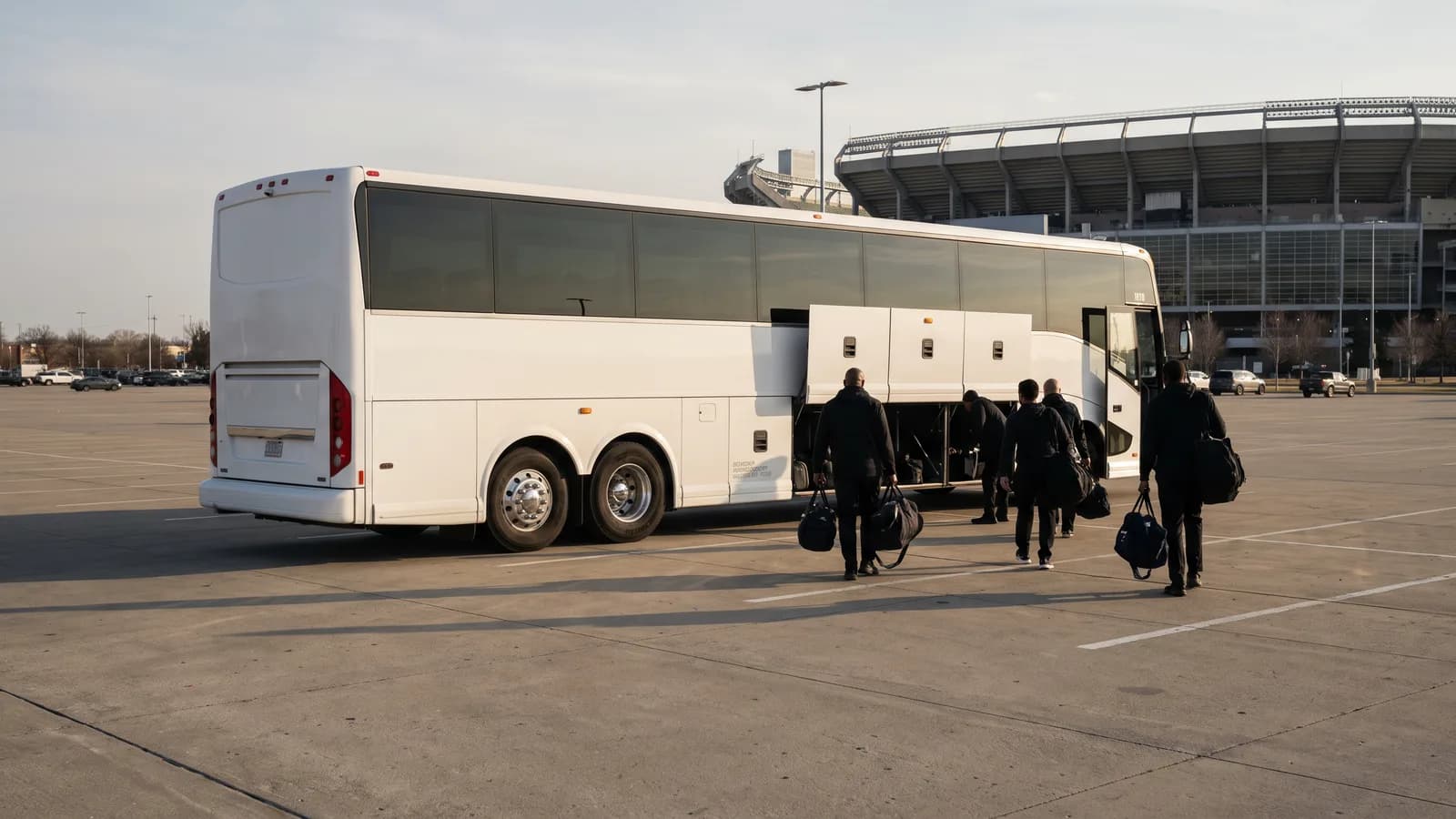
Build the headcount from the travel roster, then add coaches, athletic trainers, managers, statisticians and any parent chaperones. The driver isn't counted.
Match the total to a bus class: a Sprinter seats up to 15, a mini bus up to 26 and a coach bus up to 56. A 24-player roster with three staff is 27 people, one too many for a mini bus. Above 56 you need a second bus, which the form adds and prices.
Where the gear rides
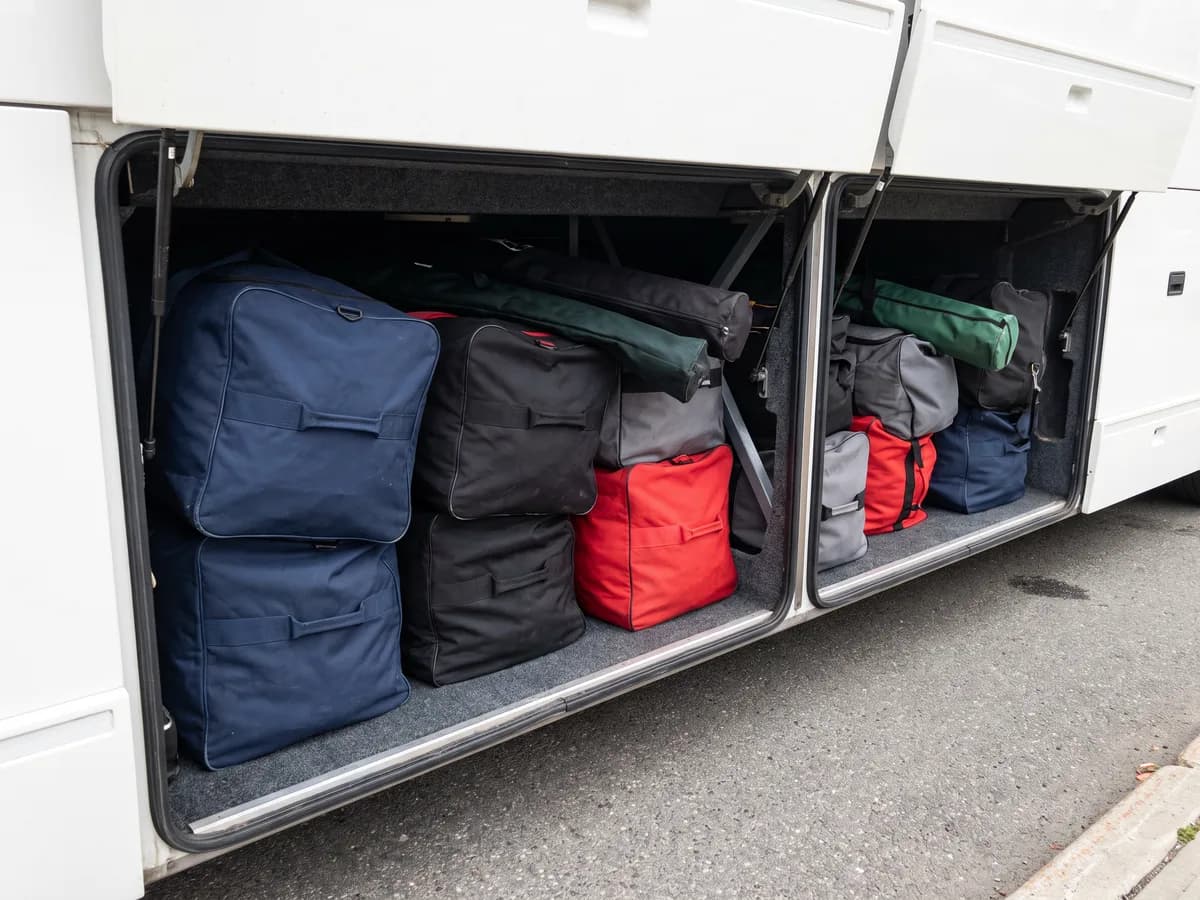
Coach buses are what federal rules call over-the-road buses: a passenger deck built over a baggage compartment (49 CFR 37.3). That under-floor bay is the place for hockey bags, bat bags and equipment cases. If you're looking at a Sprinter or a mini bus, set Luggage to “Heavy (checked bags / gear)” when you get your price and list the gear in Anything else?, so the match leans toward a bus with the room.
Anything carried inside must be stowed and secured so the driver can move freely, every exit stays clear and nothing can fall on a passenger (49 CFR 392.62). Stick bags and coolers in the aisle don't pass that test.
- Count the bags and list the big items: stick bags, hockey bags, team coolers, the medical kit.
- Bring everything to the bay at once. Loading counts toward the driver's on-duty hours (49 CFR 395.2), so a slow load uses up time you may need later.
- Bag muddy cleats and sweep for trash before you get off. Damage and extra cleaning aren't included in the price.
Set the departure from warm-up time
Work backward from when the team has to be in the locker room or on the field, not from the first whistle. Ask the host school or venue where team buses drop off and park, and who will meet you. You get the driver's name and number the day before the trip, so you can pass those details straight on.
Give the return time some slack for overtime, a long post-game talk or a team meal. The price covers the schedule you book; time past the booked return is billed to you afterwards by the hour. The bus doesn't wait at the venue unless you need it to; if you do, say so in Anything else?.
When you add up the outbound leg, count:
- Drive time, plus a cushion for traffic and a restroom stop on longer runs.
- Loading at your end. Gear takes longer to load than people do.
- The walk from the bus to the locker room at a big venue.
- Team check-in, if it's a tournament.
Long away games and driver hours
After 8 consecutive hours off duty, a bus driver may drive up to 10 hours, and may not drive at all once they've been on duty for 15 hours (49 CFR 395.5).
On-duty time is more than driving. It includes the pre-trip inspection, loading, and time spent ready to drive, so waiting with the bus through the game counts unless the operator relieves the driver of all work (49 CFR 395.2).
Run the numbers before you book. Four hours each way plus a three-hour game is right at the edge: add the drive from the operator's yard to your school and back, a cushion for traffic and time to load, and the day comes to about 10 hours of driving and 14½ hours on duty. One slow stretch of highway and it doesn't fit. Five hours each way doesn't fit one driver at all; that day needs a second driver or an overnight, and the instant price includes it when you enter your real times. Check your own trip with the calculator in the driver-hours guide, and call (704) 368-1515 if it's close.

Tournament weekends and playoff runs
A weekend tournament is a multi-day trip, and it gets an instant price too: choose Round trip and set the return date to the day you head home. The bus stays with the team; add the hours you'll use it on each day between, like rides from the hotel to the fields. A bus shuttling between the hotel and the fields all day is the Shuttle trip type, booked one day at a time. A second pickup at another school is an extra stop: enter it in the form. Extra stops don't change the price unless they add a lot of miles.
- Share the full schedule. The 10- and 15-hour clocks reset only after 8 consecutive hours off duty (49 CFR 395.5), so a late final followed by an early game the next morning can leave the driver short.
- Ask the hotel where a full-size coach can park overnight. If it doesn't allow buses, parking nearby is the team's cost, on top of the quote.
- The driver's room is the team's cost, within reason, on top of the quote.
- A playoff trip booked 14 days out or closer is paid in full when you book.
- Know the refund schedule before you commit. Cancel 14 or more days before the trip and you get 100% back; 7 to 13 days, 50%; under 7 days, nothing. That schedule holds when a game is cancelled, a date moves or a team is knocked out early. If no operator can be found, or the operator can't run and can't be replaced, everything is refunded.
Youth teams: what stays with the club
Permission slips, medical release forms, emergency contacts and chaperone ratios are set by your club, school or league, not by the bus company. Collect them before departure and keep copies on the bus. Decide which adults supervise on board; the driver is there to drive.
Planner checklist
- Headcount: players, coaches, trainers, managers and chaperones (the driver isn't counted).
- Bag count, with the big items listed.
- The time the team must be in the locker room or on the field.
- The host venue's team-bus drop-off and parking spot, and who meets you.
- A return time with slack for overtime and a team meal.
- Drive time each way checked in the driver-hours calculator.
- Youth teams: permission slips, medical forms and emergency contacts collected, with copies on the bus.
- Trash bags and a bag for muddy cleats.
- The driver's name and number (sent the day before) shared with the coaching staff.
- The operator's SAFER record checked from the link in your confirmation.
What the instant price covers
Instant price: one day or more, any headcount (past 56 people the form adds buses), such as a same-day away game or one tournament day, all-in (driver, fuel, gratuity, tolls, parking, repositioning miles and any tax). Extra stops go in the form, and a tournament weekend or any overnight gets an instant price too (Round trip, with a later return date). A hotel-to-fields shuttle is the Shuttle trip type in the form, one day at a time.
How the price is built, what it includes and how booking works: How it works.
Common questions
Do we tip the driver?
Gratuity is already in the price, and nothing is added at pickup.
Can we get WiFi for the ride home?
You can request it as a paid extra. It's not guaranteed: if the bus doesn't have it, it comes off your bill.
A player or coach uses a wheelchair. What do we do?
Tick the wheelchair-lift box when you get your price; the lift is confirmed with you before the trip. Charter coach operators may ask for up to 48 hours' notice (49 CFR 37.189), so tell us early. An accessible coach has at least two wheelchair spaces (49 CFR 38.159); an adaptive team that needs more should call (704) 368-1515.
What if the game runs late?
Build slack into the return time when you book. If the day still runs past it, the extra time is billed to you afterwards by the hour. Call (704) 368-1515 as soon as plans change; it's answered 24/7.
Can we pick up players at two schools?
Extra pickups are priced by hand. Call (704) 368-1515 with the addresses and times.
Keep planning
- How far can a charter bus go in a day?Federal rules give charter bus drivers 10 hours of driving and 15 on duty. What counts, how trucking differs, and when a day needs a second driver.
- Which charter bus fits your group?Sprinter, mini bus or coach bus? How seats, luggage, restrooms and wheelchair lifts differ, and what to do past 56 riders.
- Booking a charter bus for a school field tripDistrict rules, school bus vs. coach bus, loading zones and chaperones: what to settle before you book a field-trip charter bus.
- Charter buses for corporate eventsPlan a bus for an offsite, conference dinner or airport arrival: venue staging, accessible coaches, vendor paperwork and how to check the operator.
- Plan a group trip by charter busField trips, church retreats, team travel, corporate events, weddings and public-agency trips: a planner for each, plus how to pick the right bus.
Sources
Based on the primary sources below and fact-checked line by line, last on October 7, 2026. Rules change: the operator confirms what applies to your trip, and (704) 368-1515 answers questions 24/7.
- 49 CFR 37.3 defines an over-the-road bus as “a bus characterized by an elevated passenger deck located over a baggage compartment.” eCFR · checked 2026-10-05
- 49 CFR 392.62(c): baggage or freight on a bus must be stowed and secured so the driver has unrestricted freedom of movement, every occupant has unobstructed access to all exits, and occupants are protected from injury by falling or displaced articles. eCFR · checked 2026-10-05
- 49 CFR 395.5(a): a passenger-carrying CMV driver may not drive more than 10 hours following 8 consecutive hours off duty, or drive after having been on duty 15 hours following 8 consecutive hours off duty. eCFR · checked 2026-10-07
- 49 CFR 395.2: on-duty time runs until the driver is relieved from work and all responsibility for performing work, and includes inspecting the vehicle, loading or unloading it (or supervising or assisting), and remaining in readiness to operate it. eCFR · checked 2026-10-07
- 49 CFR 37.189(c)–(d): a charter or tour (demand-responsive) over-the-road bus operator may require up to 48 hours' advance notice to provide an accessible bus, and with less notice must still provide one if it can with a reasonable effort. eCFR · checked 2026-10-07
- 49 CFR 38.159(a)(1): an accessible over-the-road bus must have a lift or ramp and at least two securement locations and devices. eCFR · checked 2026-10-07
- FMCSA's SAFER Company Snapshot can be searched by USDOT number, MC/MX number or company name and shows a company's safety rating (if any), a roadside out-of-service inspection summary and crash information. safer.fmcsa.dot.gov · checked 2026-10-07
Photos are illustrative. Your bus is the size you book; its make, model, colors and markings vary by operator.